

BALDEV'SLiving Tradition

A Humble Account

About Baldev's

Written in the first person, with respect for what has been received and caution about what cannot be claimed.

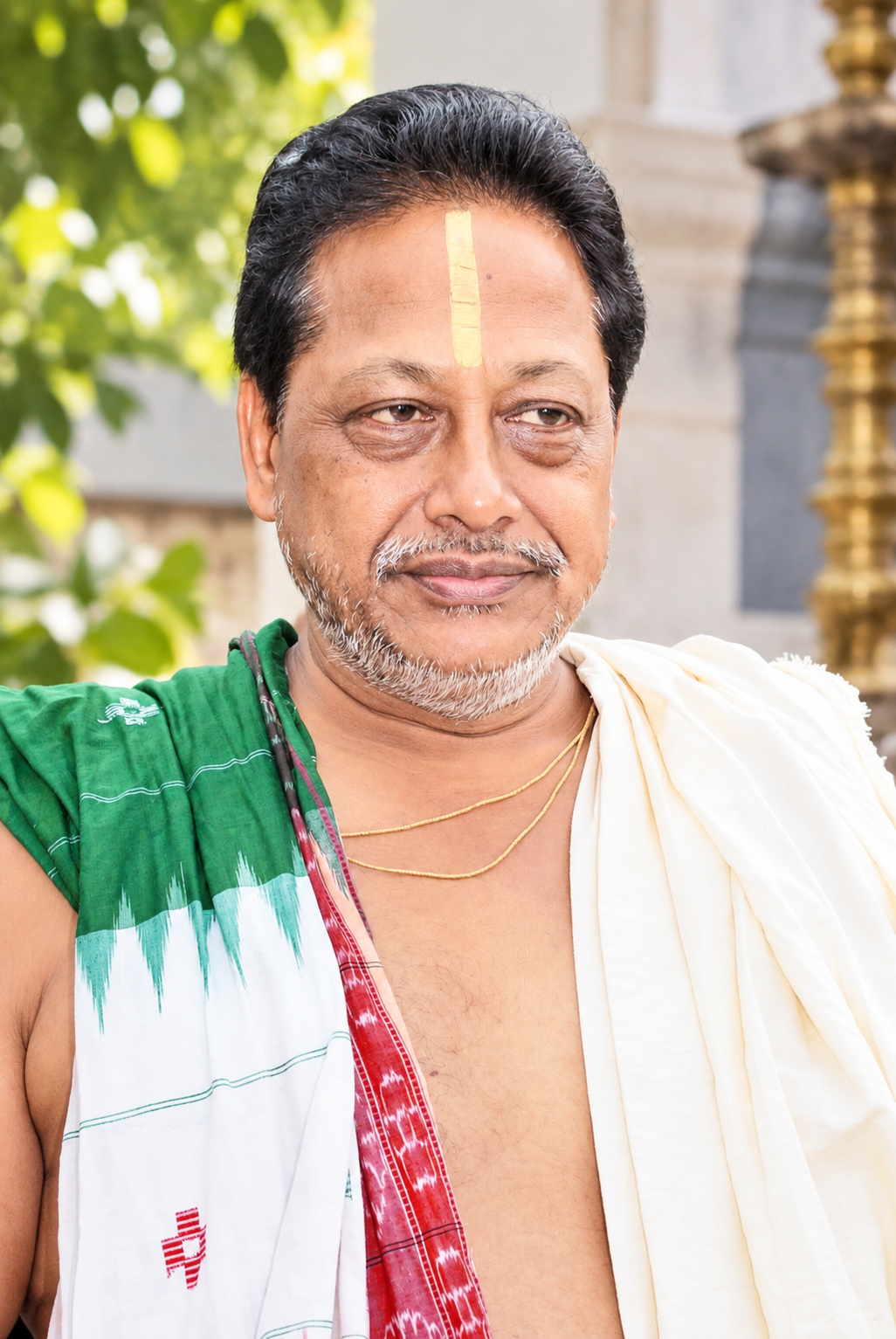
Shri Bada Thakura Badagrahi Haladhar Das Mohapatra

01

My Spiritual Journey

I was born into a family whose days have always been measured by the rhythm of the temple — the first arati before dawn, the closing of the doors at night. Service was not something I chose; it was the air of the household I grew up in.

As a child I learned by watching. Later, I learned by doing, under the guidance of elders who corrected gently and expected sincerity above all. What I know today has been received, not invented.

02

Service to Lord Balabhadra

My family's association is with Lord Balabhadra, the elder among the sacred siblings of the Ratnasimhasana. To be connected with His seva is to be reminded, daily, of strength exercised with restraint and of protection offered without display.

Details of specific ritual duties are shared here only in the measure that tradition permits, and only as confirmed by the elders of the lineage.

03

The Responsibility of Tradition

A traditional role is not a title. It is a set of obligations — punctuality, purity, discipline, discretion, and the willingness to place the deity's service above personal convenience.

Responsibility also means honesty about the limits of one's knowledge. Where I do not know, I say so. Where a claim is uncertain, it is marked as such on this website.

04

Preserving Jagannath Sanskruti

Much of what sustains this culture is unwritten. It survives in the memory of families, in the sequence of a ritual, in a phrase of Odia that has no exact translation.

Documenting this responsibly — with permission, with accuracy, and without revealing what must remain within the tradition — is among the most urgent tasks of our time.

05

A Vision for Future Generations

My hope is simple: that a young person in Puri, or anywhere in the world, can find here an honest introduction to Jagannath Sanskruti — and feel invited to learn more from authentic sources.

If this work helps even a few people understand why a ritual is performed, rather than only how, it will have served its purpose.

The Most Important Work

Carrying Jagannath Sanskruti Forward

Jagannath Sanskruti is not only a heritage of the past; it is a responsibility towards the future. Continuity depends on five quiet efforts.

TRADITIONAL KNOWLEDGE PRESERVATION

  • Documenting oral traditions with the consent of elders.
  • Recording ritual knowledge responsibly and within permitted limits.
  • Preserving stories, customs, and cultural practice in context.

YOUTH EDUCATION

  • Introducing younger generations to Jagannath culture in their own language.
  • Encouraging cultural awareness alongside formal education.
  • Connecting traditional wisdom with modern learning.

DIGITAL PRESERVATION

  • Websites, archives, photography, and educational material.
  • Making authentic cultural knowledge accessible globally.
  • Protecting records against loss and distortion.

COMMUNITY PARTICIPATION

  • Helping people understand the meaning behind rituals.
  • Promoting shared cultural responsibility.
  • Supporting heritage preservation efforts in Puri and beyond.

MODERN RELEVANCE

  • Compassion and equality as daily practice.
  • Service and humility in public life.
  • Harmony between people, and with the natural world.

Tradition survives when it is understood, respected, practiced, and passed on.

Jagannath Sanskruti is not only a heritage of the past; it is a responsibility towards the future.

Learn, and then pass it on

If this record helps one reader understand why a ritual is performed, rather than only how, it has served its purpose.